
Elephant with Graphite

Lessons
About This Lesson Series...
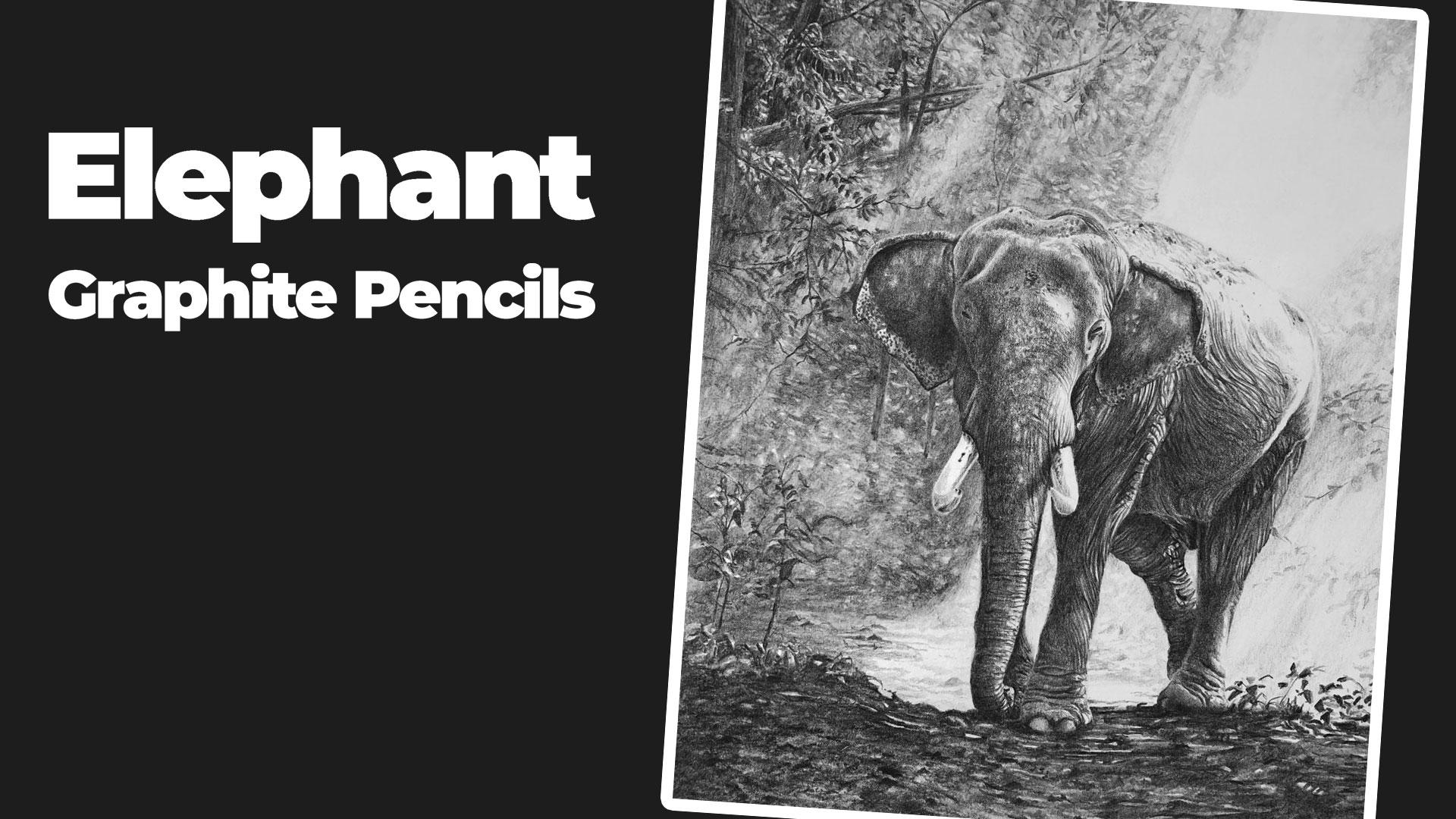
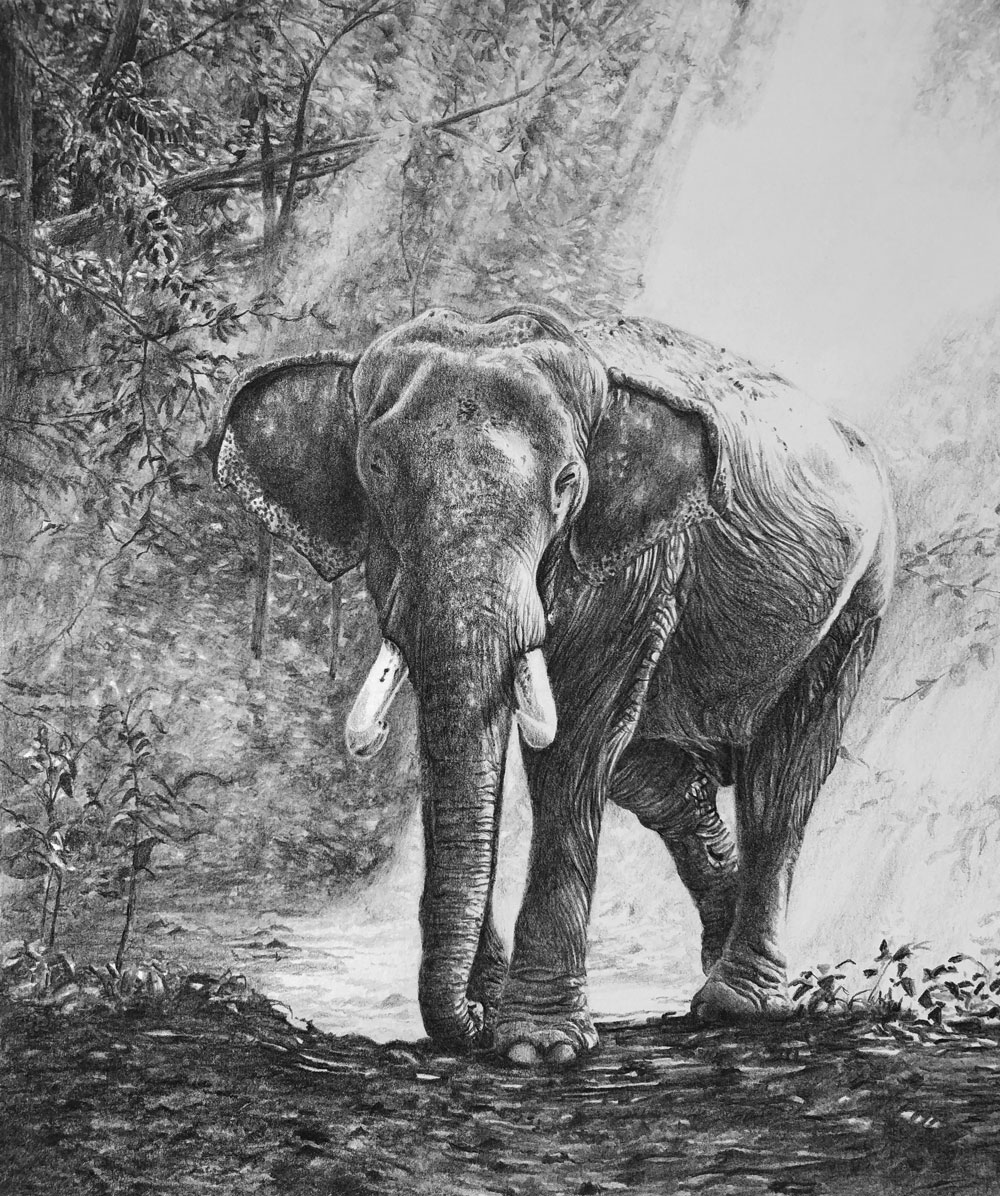
This series of lessons is an immersive and richly detailed drawing course that guides students through the creation of a highly realistic graphite portrait of an elephant in a jungle setting. Over multiple lessons, students learn how to approach a complex observational subject with confidence, patience, and precision. This series emphasizes careful observation of form and value, effective use of a full range of graphite tools, and thoughtful attention to texture and composition. Whether you’re an intermediate artist or looking to take your realistic drawing skills to the next level, this series offers in-depth instruction that builds strong foundational skills and artistic awareness.
Observation and Structural Planning
The series begins with a focus on observation — one of the most critical skills in realistic drawing. Students are encouraged to study not only the elephant’s proportions, anatomy, and characteristic textures, but also how it interacts with its environment. This includes observing the play of light and shadow across large masses and fine details, and understanding how background foliage and atmospheric perspective contribute to a convincing scene. Careful visual analysis sets the stage for accurate and expressive drawing, anchoring later techniques in clear visual information rather than guesswork.
Mapping and Proportions
Once observation skills are sharpened, the next step focuses on mapping out the composition on the drawing surface. Using light graphite, students begin sketching the elephant’s outline, establishing accurate proportions and placement within the jungle environment. This foundational step ensures that the trunk, ears, tusks, and body mass relate to one another harmoniously, avoiding distortion or imbalance as shading progresses. This lesson stresses the importance of a solid beginning in setting up a drawing that feels structurally sound and visually compelling.
Developing Value with Graphite
With the initial layout in place, the series transitions into building a full range of values using graphite pencils. Through layering techniques and controlled pressure, students learn how to create smooth transitions between light, midtones, and dark shadows. This section teaches how to depict the elephant’s leathery skin, deep creases, and subtle planes using a mix of pencil grades. It also demonstrates foundational value placement that enhances the form’s dimensionality, making the elephant appear substantial and grounded within its setting.
Rendering Texture and Detail
A defining element of this series is the attention given to texture — particularly the elephant’s deeply wrinkled skin and the varied foliage of the jungle. Students explore how to use varied graphite strokes, pressure adjustments, and blending techniques to suggest rugged textures without losing clarity. This lesson emphasizes observing both large textural areas and fine details, such as the shallow lines around the eyes or the distinctive patterns in leaves, helping the drawing feel rich and tactile.
Atmosphere and Background Integration
As the figure of the elephant comes into focus, the lesson series also addresses the jungle background, teaching how to suggest depth and distance using softer edges, lighter values, and atmospheric perspective. Students learn how to balance detail in the focal subject with controlled background complexity so that the elephant remains the centerpiece while still feeling integrated within a believable environment.
Refinement and Final Harmony
In the final stages of the series, attention turns to refining contrasts, sharpening focal areas, and enhancing overall compositional harmony. Students learn how to evaluate the drawing as a whole, making adjustments to value relationships, edge quality, and textural balance to unify the piece. By the end of the lessons, you’ll have completed a dramatic and highly detailed graphite drawing of an elephant in the jungle, along with a deeper understanding of observation, value control, texture, and atmospheric integration essential to realistic drawing.
Here's what you'll need...
- Stonehenge paper (Warm White)
- Drawing pencils
- Kneaded eraser
- Blending stumps

Founder of The Virtual Instructor, artist and teacher. Matt makes learning art easy to understand and enjoyable.
Please do the elephant first!!
Hello Matt! I know I will love this series. I have a question about the paper. I have recently acquired a large supply of paper (mostly watercolor). But I also have other papers… except for Stonehenge. Since I am on a budget, I am trying to determine which of the papers I have would be the best alternative. So, I have Canvas Paper (from Strathmore); Aquabee Co-Mo (820) said to be all purpose sketch book although it has a slight texture to it; Ingre paper for charcoal and pastel from JM Paillard – a defunct French company; charcoal paper from Demco and, finally, I have Bristol paper from Canson. If you don’t mind, could you suggest the “best alternative” to approach the Stonehenge texture? Sorry I can’t provide more information on some of these papers. Thank you for your assistance. I am hoping you will have a chance to respond to this in the next recording of the live lesson as it is possible that I won’t be able to join the live lesson. Thanks again.
Hi Patricia,
Sorry I missed your question earlier! I would go with the Bristol paper by Canson. It would be the best choice from the paper that you listed.
Thank you Matt! I can’t wait to get started on this one. I love both the subject matter and the black and white drawings.
Matt what size Stonehenge paper are you using?
Thanks
Melanie
Hi Melanie,
Sorry! I’m just seeing this question! The drawing surface is 10″ by 12″.
I just heard your comment on developing a skill and that it takes lots of hard work. I find that very encouraging. I feel like I have zero percentage talent. I’m seeing this is a skill that can be developed like skills in sports and music. I was under the mistaken belief that artist were pure talent.
How important is the paper selection? I just joined and is there a video and lesson on paper?
Thanks,
Carol
Hi Carol,
Welcome! The paper is VERY important. I have video here, if you’d like to check it out…https://thevirtualinstructor.com/blog/all-about-drawing-papers-and-surfaces
I am using 70 pound drawing paper, but my drawing has most definitely not failed, like you said it would.🤨🐘
Peter👍🏻
Hi Peter,
I’m not sure what to make of your comment. I don’t believe I have ever said that a drawing would fail if you worked on 70 lb drawing paper.
Hi Matt
For beginners this drawing ist very,very ambitous. All the values and the creation of illusion of the leaves, the rays of sunshine the skin of the elephant with the wrinkles and all those shadows. I followed your lesson about the tree (Subjects with Pen & Ink, Lesson 22 Tree) and my drawing didn’t satisfy me. It was too dark, the illusion of leaves didn’t emerge. Hopefully with graphite the illusion of shadow and leaves succeed better. It is such a wonderful photo to draw and I am so eager to draw the content beautifully. The contour of the elephant along the grid, was great I managet it very well (at some point I had to trust really the grid – as you mentioned – and it was worth it). I am now anxixous to go further to the background and the elephant, anxioux about destroying the silhouette of the elephant with a bad, messy background :O(.
Martina
yep, my tree comes down to the elephant’s top of his ear to blk 5 where Matt you are up two blocks higher above the elephants ear?
I agree with you Matt as a beginner this is very very ambitious but I know once i am ready i will tackle it in the very near future in the meantine practice and more practice. Thank you for your lessons. Sahara
I joined last summer and absolutely loved it. I’m so thankful that someone like you had the time and effort to create something like this for people to watch. Since school’s about to go out, I don’t know what to do with all my time, and I’m really passionate about art and want to get better. Again, thank you so much and I just want to express my gratitude by writing this message.
Still wondering how to get this course on my smart TV rather than just phone or computer?
And also interested in if there is any critiquing along the way. Im a beginner to this program and would love to continue from where I left off without so much looking of finding this elephant class.
Thanks for any help, Therese
I don’t know where you are located but Dale Chihuly is in Seattle Tacoma. He has a glass studio in Seattle and a museum in Tacoma. His work is everywhere you go. 🙂
I have absolutely loved drawing the elephant but I’m exhausted! I have never attempted such a detailed drawing before and am really happy with the result! Thank you Matt!
From Sheila, in Kent UK
It is amazing how exhausting it is! Just drawing the elephant outline in the first session was exhausting (in a good way…learning patience and concentration).
Wonderful drawing, thank you Matt.
Also, speaking of graphite artists, check out Laurie Lipton. She does HUGE graphite drawings. They are dark (content-wise) but I love her work. And there’s a great short documentary about her called Love Bite I highly recommend (free to watch on vimeo).
Even with the grid, I keep getting lost in the leaves!! I find myself outlining them so I can keep track of where they are, but then that looks bad.
It’s really tricky.
Hi Matt,
Curious if have all of these vids on a private YouTube channel for members? Only asking because it’s easier to watch them on a big screen (smart tv). No biggie, either way your course is great!
Thanks,
Aaron