
House Portrait with Pencil

About This Lesson Series...
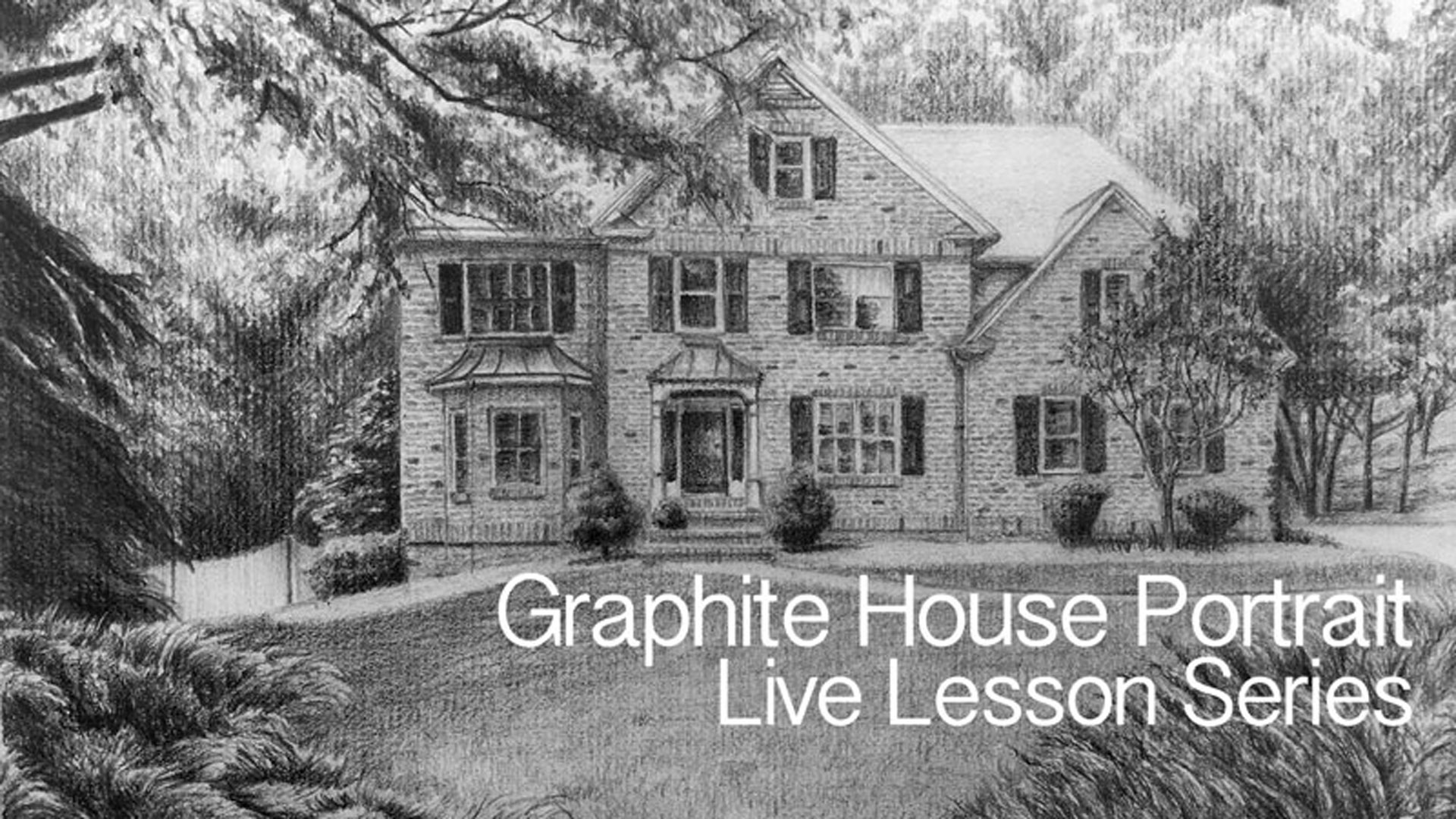
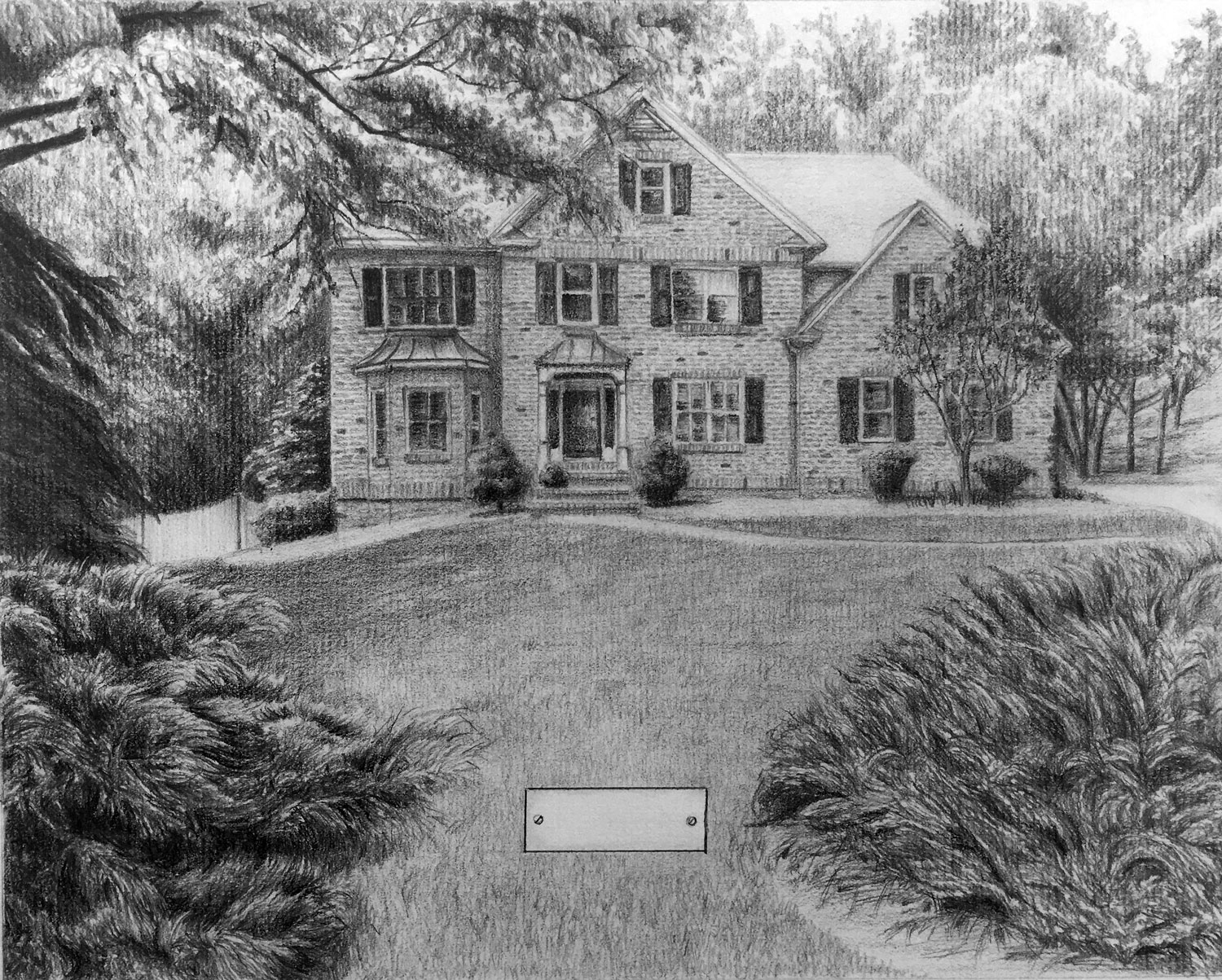
In this comprehensive lesson series, Matt guides students through the process of creating a highly detailed graphite drawing of a house on textured charcoal paper. Designed for artists who want to strengthen their drawing accuracy and rendering skills, this class breaks down what can often feel like an overwhelming subject into a clear, manageable process. With a focus on observation, measurement, and mark-making, students learn how to translate complex architectural forms into a convincing and polished drawing.
A Complete, Start-to-Finish Drawing Experience
This nine-part series provides over nine hours of in-depth instruction, giving students the opportunity to follow along through every stage of the drawing. From the initial layout to the final details, each lesson builds upon the last, ensuring that no step is overlooked. Matt demonstrates how to approach the subject methodically, helping students develop both patience and confidence as they work through the process.
The course begins with establishing the overall structure of the house using light graphite lines. Students are introduced to comparison techniques, which allow them to measure relationships between shapes and angles to achieve accurate proportions. This foundational step is critical when working with architectural subjects, where even small inaccuracies can become noticeable.
Mastering Proportion and Perspective
One of the key focuses of this class is learning how to draw structures with precision. Matt explains how to simplify complex forms into basic shapes, making it easier to understand perspective and alignment. By using tools such as a ruler alongside careful visual measurement, students learn how to create clean, straight edges and maintain consistency throughout the drawing.
This emphasis on structure ensures that the drawing feels solid and believable. As students progress, they gain a deeper understanding of how angles, spacing, and proportion work together to create a realistic representation of a building.
Developing Texture with Graphite
Once the structure is in place, the focus shifts to rendering textures. Working on charcoal paper provides a slightly rough surface that interacts beautifully with graphite, allowing for rich variations in value and mark-making. Matt demonstrates how to use different pencil pressures and strokes to suggest materials such as wood, brick, roofing, and surrounding elements.
Students learn how to build layers gradually, creating depth and dimension through controlled shading. Rather than relying on heavy blending, the course emphasizes intentional marks that enhance the surface quality of the drawing while maintaining clarity and detail.
Building Depth Through Value and Contrast
As the drawing develops, attention turns to light and shadow. Matt shows how to establish a full range of values, from subtle midtones to deep shadows, giving the house a three-dimensional presence. By carefully observing how light interacts with the structure, students learn how to create contrast that enhances realism without overwhelming the composition.
This stage also includes refining edges and adjusting values to ensure harmony across the entire drawing. The balance between light and dark plays a crucial role in guiding the viewer’s eye and reinforcing the illusion of depth.
Refining Details for a Polished Finish
In the final stages, the drawing is brought to completion with careful attention to detail. Windows, trim, textures, and smaller architectural features are refined to create a cohesive and finished piece. Matt demonstrates how to know when to sharpen details and when to leave areas softer, maintaining a balance that keeps the drawing visually engaging.
Strengthen Your Drawing Skills with Graphite
This lesson series is ideal for artists who want to improve their ability to draw architectural subjects while gaining confidence with graphite techniques. With clear instruction and a structured approach, Matt makes it possible to tackle complex subjects with ease. By the end of the class, students will not only complete a detailed house portrait but also develop skills that can be applied to a wide range of drawing subjects.
Here's what you'll need...
- Charcoal Paper
- Graphite Pencils
- Kneaded eraser
- Ruler

Founder of The Virtual Instructor, artist and teacher. Matt makes learning art easy to understand and enjoyable.
Matt please don’t do much homework, Because I depend totally on recorded live lesson videos to draw. I can’t do it on my own I’m sorry 🙁
Hi Sumana,
I’ll keep the homework that I complete to a minimum in the early stages of the drawing.
That’s great. Thanks! 😊
Interesting to see the diligence doing the bushes. Sometimes, it seems, family & friends would have you think your “compulsive” and it is good to see here that it is more like diligence. I think it helps keep self-doubt from hampering the learning process.
Hi Margaret,
Thanks! Yes, it is a slow process – but well worth it in the end.
Hi Matt, I just wanted to tell you that I sent you an email about 3 weeks ago but didn’t get a reply from you yet so I sent you 2 additional emails regarding my 1st email last week and they are really important! Did you get them by any chance? Before, you were usually faster in replying to emails so please let me know …… Thanks!
Hi Nikki,
I replied to your email and was wondering if you got it, since there was no reply back. The last email from me was sent on February 15. I’ll send it again, but you may check and see if you received it.
your camer light is slightly too on your page and we cant see your lines very well ,, just food for thought ,, but … your fantastic ,, regardless
It was disappointing for me to find (a first too) that your feed kept buffering. I have downloaded some updates but I can’t figure why suddenly, I begin having problems with the HD. This laptop is supposed to be HD. I will look forward to the last half hour of #5 when you add it to the others. Thanks for this opportunity to see you work a house portrait. And, I love your ruler. So much potential for parallel straight edges. The 4th session you lost your little ruler and I was going to suggest that it went back to the sewing room. Come to think of it, I might just go get one. 4 straight edges close together. Useful. 🙂
Hi Margaret,
Thanks for the comments. If the feed is buffering for you, you may be suffering from an inconsistent or weak internet connection. It likely has nothing to do with the computer 🙂
Oh, I bet that’s it. Thank you.
Matt, While digital painting might be interesting to watch, it’s not something I would spend time doing.
Continuing to enjoy all your lessons – live and taped – over here in Tunisia!
Could you explain why you use charcoal paper.
Hi Janie,
Charcoal paper has a unique texture – it is a laid paper. This unique texture works well for developing certain textures like the trees and bushes in a house portrait like this. It also gives the finished drawing a unique look. Just because the paper is labeled as charcoal paper doesn’t mean that you can’t apply other drawing mediums to it.
I am learning Photoshop. It would not replace traditional art for me but I find I really enjoy learning what it can do. I was especially surprised to find the artwork that was possible using the “brushes”. I would find a Live Lesson quite interesting. It seems to have potential as another learning tool in working value, light, & color.
you were right when you said that the final result worths the effort. it’s outstanding and precious lesson! Thanks for your careful teaching!i drew along with recorded lessons and I finished it today. I love it so much ^^
My feed keeps cutting out but my internet connection is fine.
Hi Patricia,
The videos are set to play in high definition by default. If they are freezing on you, then you’ll need to turn the HD off. To do so, scroll over the video and click on the “HD” icon. Although your internet connection may be stable, streaming in HD requires a fast connection as well.
Hi Matt,
Do you lay your drawings flat on a desk or have it tilted?
Thanks..New member
Beverley
Hi Beverley,
I prefer to work at a slightly tilted angle. By doing so, it prevents any distortion that may occur from looking at the drawing on a flat surface.
Nice photos. But looks difficult to do. I am just watching it right now.
I loved this lesson and watched all 9 episodes. I’m new here and haven’t drawn since I was a kid and now am in my 60’s. I’m drawn to architectural subjects so was interested to see this series. I wonder though, why Matt didn’t put more value in the fence. The photo shows it as having a darker value and, in my opinion, it’s hard to tell it’s a fence. I don’t recall that he talked about the fence in any of the episodes, unless I missed it.