
Line and Wash - Boat on the Water

Lessons
About This Lesson Series...
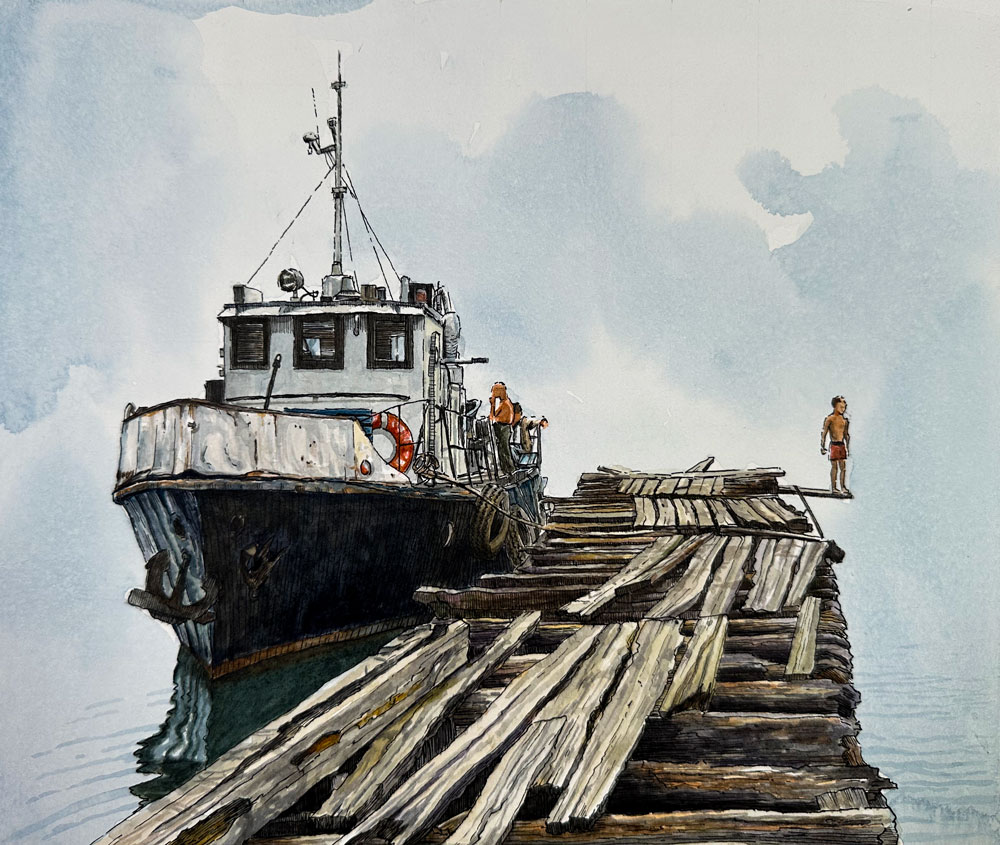
The Line and Wash: Boat on Water class guides you through the creation of a complete mixed media artwork that combines expressive pen and ink drawing with transparent watercolor washes. This lesson focuses on developing strong observational drawing skills while learning how watercolor can enhance line work rather than overpower it. The result is a balanced, atmospheric image that captures both structure and mood.
Understanding the Line and Wash Approach
Line and wash is a versatile technique that allows artists to define forms with confident lines and then suggest light, shadow, and color using watercolor. In this class, you’ll explore how line can establish clarity and detail, while washes create depth and a sense of environment. The lesson emphasizes decision-making—knowing when to rely on line alone and when to let watercolor do the work.
Drawing the Boat with Confidence
The class begins with the drawing phase, where the focus is on accurately constructing the boat using simple shapes and careful observation. You’ll learn how to capture proportion, perspective, and structural details without overworking the drawing. Special attention is given to line quality, including variations in thickness and direction, to help convey form and texture in a natural, confident way.
Using Pen and Ink Effectively
As the drawing develops, pen and ink are used to strengthen important details and add visual interest. You’ll see how controlled line work can describe surfaces such as wood, metal, and rope, while looser marks can suggest texture and age. This section of the class demonstrates how ink can create contrast and focal points before any color is applied.
Applying Watercolor Washes
Once the ink work is established, watercolor is introduced to bring the scene to life. You’ll learn how to apply light, transparent washes that support the drawing rather than obscure it. The lesson covers layering washes gradually, controlling water and pigment, and preserving highlights. Color choices are explained in context, helping you understand how limited palettes can still create a convincing and harmonious scene.
Creating Water and Reflections
A major focus of the class is painting water in a simple yet believable way. You’ll explore how horizontal strokes, value changes, and subtle color shifts can suggest calm water and reflections. The lesson demonstrates how reflections relate directly to the objects above them and how soft edges and controlled blending help maintain the illusion of depth and movement.
Adding Depth and Atmosphere
As the painting progresses, additional washes and details are added to enhance depth and atmosphere. You’ll learn how to push certain areas back while bringing others forward using value contrast and color temperature. The instructor explains how to avoid overworking the painting, knowing when to stop, and how to preserve the freshness that makes line and wash so appealing.
Materials and Surface Considerations
The class also discusses suitable materials for line and wash, including paper choices, pens, inks, and watercolor paints. You’ll gain insight into why certain surfaces work better for combining ink and watercolor and how material choices affect the final appearance of your artwork. This knowledge can be applied to future projects beyond this single lesson.
A Complete Mixed Media Experience
By the end of the Line and Wash: Boat on Water class, you will have completed a finished artwork while gaining a deeper understanding of how drawing and watercolor can work together. The skills taught in this lesson are transferable to a wide range of subjects, making it a valuable study for artists interested in sketching, illustration, or expressive watercolor painting.
Specific Lessons
Lesson 1 (1:08:14)
In lesson one, we discuss the materials and begin drawing the contours of the boat.
Lesson 2 (1:04:43)
In lesson two, we begin with pen and ink applications.
Lesson 3 (1:05:26)
In lesson three, we continue with pen and ink applications.
Lesson 4 (1:12:40)
In lesson four, we complete preliminary pen and ink applications.
Lesson 5 (1:02:53)
In lesson five, we begin with light watercolor washes.
Lesson 6 (1:15:12)
In lesson six, we begin layering detailed watercolor washes and increasing contrast.
Lesson 7 (1:05:06)
In lesson seven, we work on the details on the boat, including the figures.
Lesson 8 (1:13:45)
In lesson eight, we darken the hull of the boat and begin work on the reflection in the water.
Lesson 9 (1:03:28)
In lesson nine, we begin painting the dock and address the figure on the plank.
Lesson 10 (1:22:52)
In lesson ten, we complete the painting.
Resources for this Lesson...
Distributing any content downloaded from this site is strictly prohibited and against the terms and conditions of use.
References
Here's what you'll need...
- Hot Pressed Watercolor Paper
- Dip Pens
- Graphite Pencils
- Bottled Carbon Black Ink
- Kneaded Eraser
- Watercolor Paints
- Nylon Brushes
(Disclosure: Links to art materials are affiliate links which means we make a small commission if you purchase at no additional cost to you.)

Founder of The Virtual Instructor, artist and teacher. Matt makes learning art easy to understand and enjoyable.
For some reason I feel guilty when I don’t do art and I don’t know why. Do you do art every day and feel guilty when you don’t?
Guilty is not the word I would use. I do feel like I missed an opportunity to spend some time doing something that enriches my daily life. Just like going for a walk for example. There are so many things to do in any given day; perhaps we need to make a standing appointment for every day time doing art. 🙂
The photo reference with grid and the finished result are the same.
Thanks for that. I have replaced the file with the correct image.
Are there not any written instructions with this course? I love having those.
Hi Debra,
This is a lesson series (different from our traditional courses) Ebooks are only included with the traditional courses.
I cannot find hot press paper anywhere. Cold press ok or do you recommend something else?
Hi Matt,
What size Grumbacher brushes would you recommend for this lesson? I have only two (the 0 and 4 used in colored pencils plus). Just a quick look at this lesson makes it seem like it is a good idea to have a few more sizes on hand. Thank you!
It’s my birthday 🎁 🎉🥳
Matt, for some reason the links to the materials you use don’t work. Is it me or you?
Hi Peter,
It’s just a list of materials. There are no links for this lesson regarding materials.
What? There is no purple in Germany? Well we have lilac, purple, violet, something called Flieder, with is your lilac… we have Brombeere, with is Blackberry, we have aubergine..and so on. But i have to admitt, that there is no sharp destination between lilac and purple. I call it blue violet and red violet…
76 year old and ready to go…..never have I used water color…looking foward to the challenge!