
Candy Painting with Gouache

Lessons
About This Lesson Series...
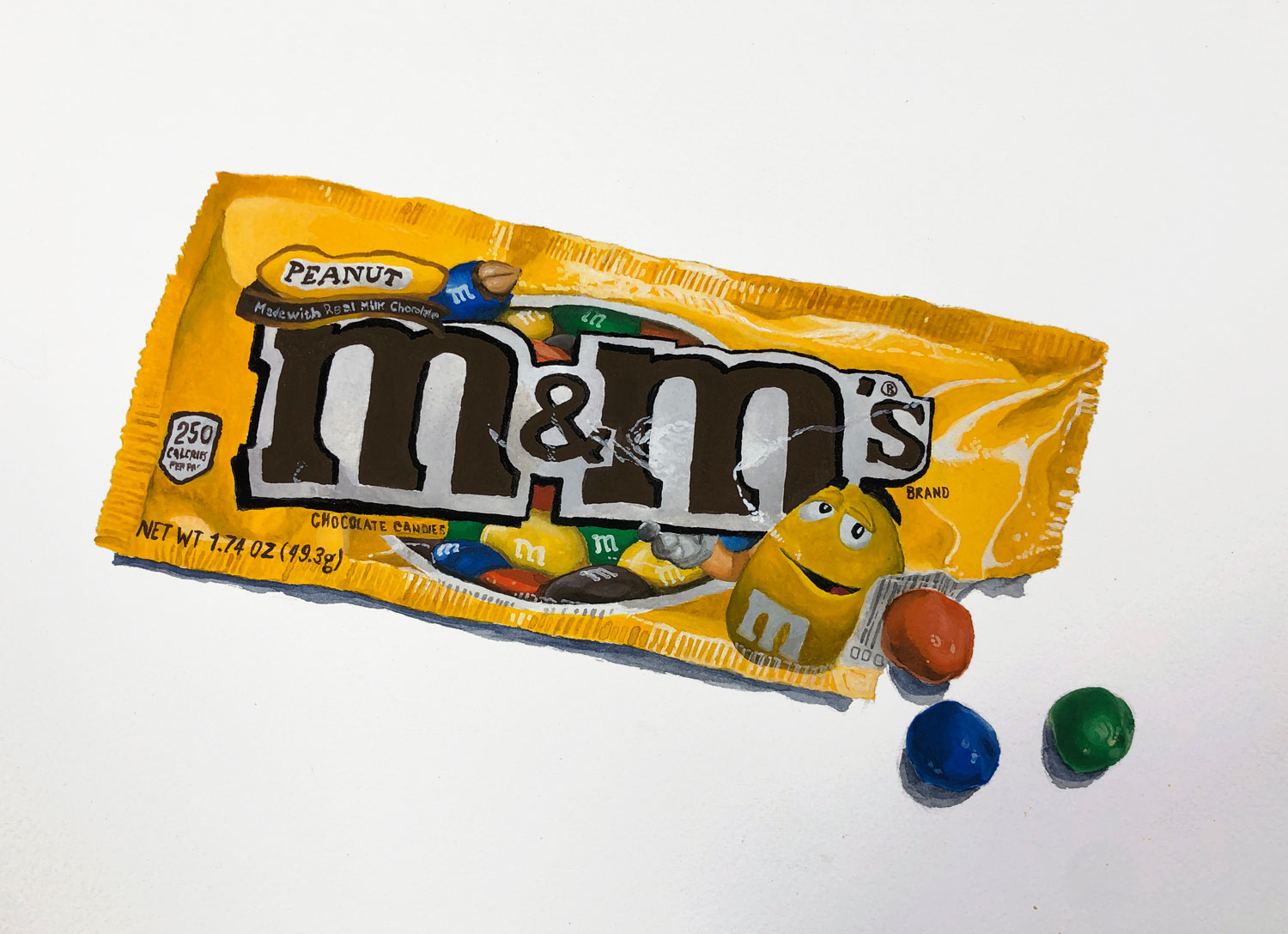
The Gouache Painting: Candy lesson series is an engaging and richly guided exploration of how to paint a vibrant still life of candy using gouache paints. Spanning eight lessons, this series leads students through a complete painting process that emphasizes thoughtful planning, confident color mixing, and expressive brushwork. Gouache, with its ability to combine opaque layers and watercolor-like washes, is an ideal medium for capturing both texture and color in this whimsical subject. Throughout the series, you’ll learn how to handle the medium with control, build depth and form, and refine details so that your finished painting feels cohesive and expressive.
Observation and Planning
The first step in the series focuses on developing a clear understanding of the subject and composing a successful painting. Observation is emphasized as students learn to see not just colors but the relationships between shapes, light, and shadow. Thoughtful composition and planning help establish a roadmap for the rest of the process, ensuring that you make intentional choices from the outset rather than reacting at each stage. This helps create a foundation that supports stronger paint layers and a more compelling final image.
Establishing Structure and Value
Once the composition is established, the series transitions into exploring the value structure of the candy still life. Using light watercolor-like washes of gouache, students begin to suggest the underlying light and shadow relationships of the objects before committing to bold color. This early tonal work builds clarity and helps simplify the complex subject into manageable visual information. Establishing value first helps guide later decisions about color and contrast, giving the painting a solid sense of depth.
Color, Harmony, and Blocking In
As the painting develops, attention turns to blocking in local color and building harmonious relationships across the composition. Students learn how to mix bold, saturated gouache hues that reflect the vibrant nature of candy, while also creating color harmony that feels intentional and balanced. Layering color gradually allows for adjustments while maintaining clarity and luminosity in the paint layers. This is a key stage where the painting begins to take on a recognizable form.
Building Depth and Form
With color in place, the next emphasis is on developing form and volume. Gouache’s opacity becomes a powerful tool for modeling the shapes of the candy and packaging, creating subtle transitions between light and shadow. By layering controlled washes and opaque strokes, students learn how to suggest three-dimensionality and weight in their subjects. There is also a focus on how to handle reflective surfaces and edges in ways that enhance realism without losing the expressive quality of gouache.
Refining Details and Texture
As the piece progresses, students refine details and explore texture more deeply, adding highlights, adjusting values, and strengthening contrasts where needed. Techniques such as softening edges, sharpening focal points, and introducing small accents help elevate the painting beyond a basic study. Attention to texture — from glossy candy surfaces to crinkled packaging — brings life and personality to the composition.
Final Enhancements and Cohesion
In the final stages, students concentrate on unifying the entire painting. Through subtle adjustments in value, color, and edge quality, the series teaches how to bring all parts of the composition into harmony. Final enhancements might include strengthening key highlights, balancing warm and cool tones, and refining transitions so the painting feels polished and complete. These finishing touches help ensure that the painting feels visually cohesive and satisfying.
Complete Gouache Workflow
By the end of the Gouache Painting: Candy series, students will have created a fully resolved still life that showcases their growing mastery of gouache. This series not only teaches specific techniques for working with color, value, and texture, but also helps artists develop a confident workflow — from early observational planning through to thoughtful refinement and finish. The skills gained here are widely applicable to many subjects, making this an excellent study for anyone looking to deepen their gouache practice.
Here's what you'll need...
- 140 lb Cold Press Watercolor Paper
- Hard Graphite Pencil
- Soft Graphite Pencil
- Gouache Paints
- Nylon Brushes
- Kneaded eraser
- Water
- Masking Tape

Founder of The Virtual Instructor, artist and teacher. Matt makes learning art easy to understand and enjoyable.
Congratulations on the use of your video, Matt! That’s quite a kudos. On the subject of qouache, I’ve tried to use it to add highlights on watercolor paintings and it doesn’t cover very well. I’m thinking it could be the cheap paints I picked up so I’ll have to try a tube of Windsor-Newton.
JD Brown, I read your comments on the Gouache painting and want to you for the warning when looking for top quality tools if you expect top performace in the art you produce. Also the try and learn using different quality can be helpful in the improvement stages along the way. Thanks for the post..
Matt does a wonderful job I think, what you feel or think about the lessons?
Hi Jimmie,
I’ve not found any online instructor, or anywhere else for that matter, that meets Matt’s level of instruction. I have to give him credit for getting me out a number of bad habits and bad attitudes toward my art. I never pushed myself much further than graphite until I found Matt’s site and decided ‘hey, I can do this’. May sound strange but it is what it is. LOL
Good luck with your art.
I am sure you and your family are celebrating on your earned success. There used to be an old-fashioned expression when I was growing up, “Those who cannot do, teach.” Not so with you, our talented Instructor!!! You have rewritten the old adage to, “Those who can do, can both be a wonderful artist and great teacher. I was thrilled when I found your courses and plan to study along with the rest for time in perpetuity I graduated from Boston University with a BFA in acting – started in theatre when I was 12 years old doing summer stock with a Canadian company which was based in NYC in the winter and Dorset, Vermont in the summers. When I had my first son, I reluctantly gave up on my career as I was afraid I would continue to be too involved in my profession and not my boys’ sports endeavors but brought them up in the Fine Arts. I know I made the right decision. I then decided when they were grown to see if I could paint or draw or something to do with the fine arts — I lived on Sanibel Island, Florida and took lessons in first oil painting which ruined my watercolor career before it even began — I thought for life until I happened upon your methods of teaching — so. now because there is a glimmer of shining hope, I began with the basics last month with you and am loving your program. You talked about as we started out — whether in watercolors or oils — will probably dictate the direction we choose to put color onto paper — and how right you are. When I first began classes, I took a week-long class with the now famous Chinese/American painter Lian Quan Zhen and loved his class so much, I went to China for a painting tour he takes students on every year. I loved painting every day all over China; however, I struggled with watercolor then and am still struggling. I am confident you can break me of my bad habits acquired from beginning my artistic endeavors painting in oils. I am sure also I will be slow to finish projects, as I am now 79 years old and need more sleep than before. I will send you something to critique when I complete the sea turtle (am using the pen and ink method for the first time) and the gouache candy piece (have never used gauche before) but as you said, I love it because I began painting in oils. I cannot wait to start another lesson but must learn to be patient and proceed slowly! Lian’s wife paints the “old Chinese watercolor style” as opposed to his more modern paintings and, like you and your wife probably did, they started small but now give classes all over the world and give a great Chinese cooking school/painting week in the mountains some place. You, however, are bypassing the small stuff and are exhibiting with great Masters! I will look for your work in museums in the future! I have to study watercolor painting with you so I can use Lian’s books (I have a good collection) and maybe finally will learn to paint with his complicated-for-me techniques — another project in addition to taking every one of your ongoing courses! Anne
Hi Matt – I had to order the permanent yellow deep because I only had the primary yellow. I won’t get the yellow from Dick Black for another 7 to 10 days. I have been attempting to paint the lesson by mixing in some red and brown with the primary yellow. Do you have any suggestion or is this mixed color the best I will be able to achieve?
Hi Anne, you could wait for the paint to arrive or you can continue on mixing your own yellow. You may actually find that the mixed version creates a more natural appearance since there will likely be small variations in the color, which is closer to what we actually see in reality.
Matt What do you think of Arteza Paints?
Hi Annette,
I’ve never used them before. I think they are relatively new. Maybe I can check them out.
Nicely done! A suggestion: why not use a gel pen for the lettering?
Thank you Matt, I feel reinvindicated.
Misterart.com I buy from them, excellent inventory. Fast and efficient. Good prices.
I
I really like this series, and my 5 year old brother is watching with me too!!!
I’m newbie here and I want to learn more on realistic and what available materials I have now and this reference is swak in my materials…feel so excited n when I scroll this website scream lol ..so much have to learn here …thank you Matt I found this …
I use M. Graham gouache which is available at my local art supply store. It covers very well and is comparable to Winsor & Newton in quality in my experience but is a little less expensive in my store.
I’m loving this tutorial! Matt, you have helped me tremendously in my art journey. I’ve finished the drawing and will start the gouache tomorrow, since I have other time commitments today. How exciting to have your video playing at the Napa Valley Museum! You are such a skilled artist, and an amazing teacher. Congratulations and thank you for all you do.
Hi Kathryn,
Thanks so much for your kind words!!!
I tried putting some guache in my pallette and had to walk away, after it had dried, it did not reactivate the way you spoke of. In fact, it got really hard, so hard that it just came out of the spaces even after much water. Very frustrating and a real turn off.
Hi Bearstarfire,
Gouache does reactivate with water after drying. It does not return to its liquid state, but it can be used. You may think of it like watercolor cakes. When water is added with a brush, some of the dried gouache reactivates and the color on your brush can be spread over a surface.
I found that out the hard way. Will take more care now not to put too much in my pallette at a time, though I don’t put much at all. I always did my blending with just acrylics didn’t hear of guache until the last few months. Haven’t really seen any difference between how I used to use a bit of water to blend acrylics and using the guache. Still too new to watercolor to really make a judgement there.
I remember when this happened.. the shooting. It hits home to me this week as our community is still reeling from a shooting at a local birthday party where 4 people were killed. It seems these days that there’s just too much of this going around, sadly. And yes, things like this DO affect our art in subtle and not so subtle ways. Hearts and prayers to all those dealing with death and pain.
Hi, Matt.
I was wondering, would you be in legal trouble if you tried to sell this painting?
Hi Eli,
I’m not sure why you would think there would be some legal reason not to sell this painting. I bought the candy, photographed the candy, edited the photo and then painted the image. Why do you think there would be a legal issue?