
Painting Water with Gouache

About This Lesson Series...
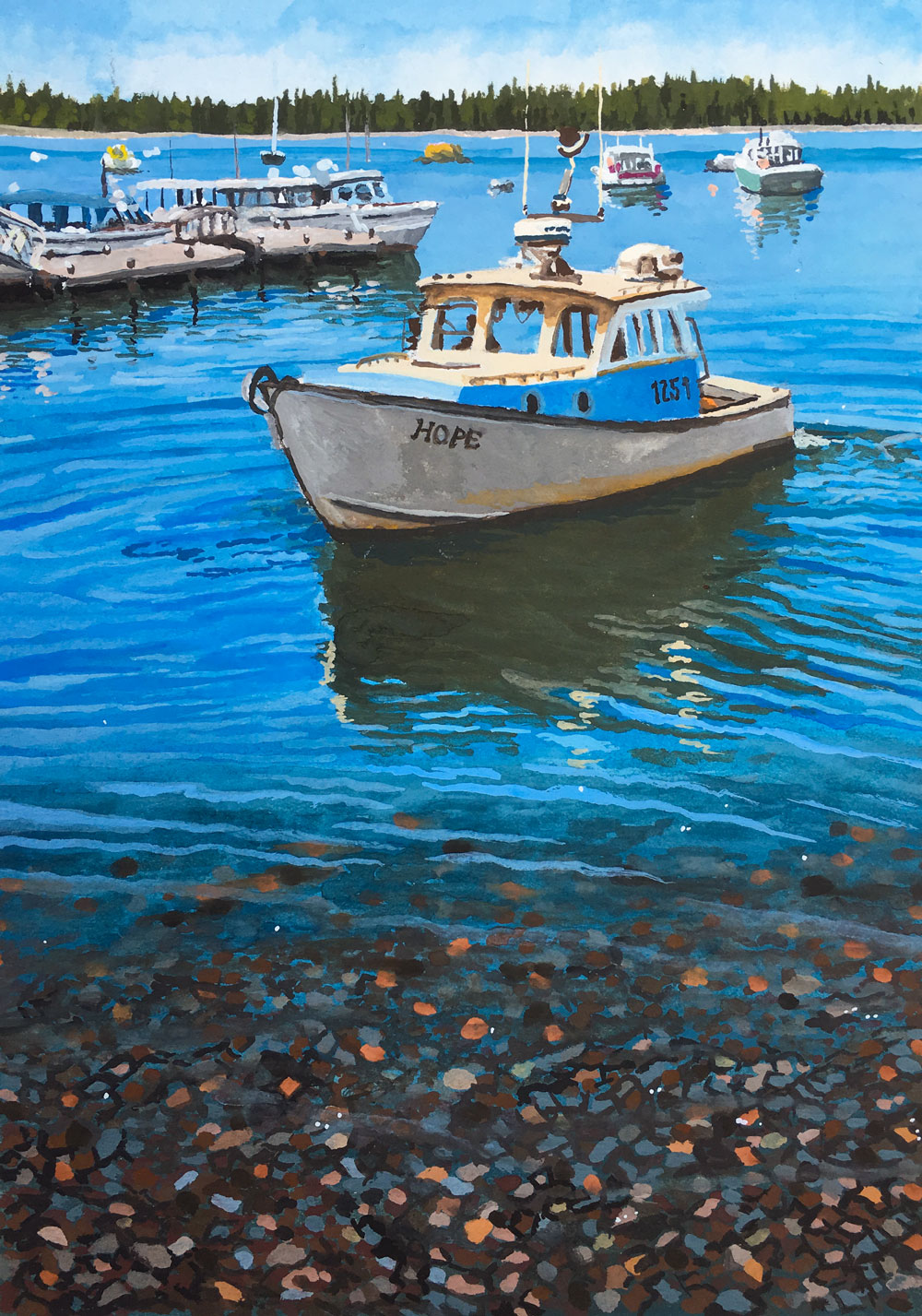
The Painting Water with Gouache lesson series is a rich and immersive exploration of using gouache paints to capture a serene and reflective scene of a boat resting upon water. Over several lessons, students are guided step-by-step through the process of transforming a blank surface into a complete composition that communicates both the visual beauty of water and the unique qualities of gouache as a medium. This series focuses on how to represent reflections, depth, color harmony, and atmospheric conditions while learning practical strategies for layering, blending, and edge control that make gouache such a versatile choice for painting water.
Setting Up the Scene
The series begins with planning the composition and understanding the dynamics of the scene. You’ll learn how to establish the horizon line, determine the placement of the boat, and observe how light interacts with water. This early planning helps you see not just the subject but the spatial relationships that shape the scene. By breaking the painting down into manageable elements — sky, water, boat, and reflections — you set up a roadmap that guides the entire process and helps maintain clarity as detail is added.
Understanding Gouache and Its Qualities
Before diving into the water itself, Matt covers essential techniques for working with gouache. You’ll learn how gouache differs from watercolor and acrylic, how its opacity can be used to create luminous layers, and how to mix colors that read clearly and vibrantly on paper. Understanding how gouache handles in both transparent and opaque applications is key to achieving convincing reflections and subtle gradations in the water. This foundation ensures you’ll work with intention rather than guesswork as the painting progresses.
Blocking in Color and Value
With a solid plan and understanding of materials, the lesson series transitions into blocking in broad areas of color. Using light, controlled layers, you’ll suggest the vast expanse of water and sky while laying down the basic hues for the boat. The instructor emphasizes the importance of value relationships — how the darks, midtones, and highlights establish depth and space. By focusing on values early, you ensure that the painting feels cohesive and that the boat feels anchored in its environment.
Developing Reflections and Movement
Next, students learn how to represent reflections and the movement of water. Gouache’s opacity and layering capabilities allow you to suggest ripple effects, subtle shifts in tone, and the mirror-like quality of calm water. The instructor demonstrates how to capture the way the boat interacts with the surface, how light dances across gentle waves, and how colors shift and soften in reflected areas. Techniques such as wet-on-dry layering and controlled blending help make these transitions smooth and convincing.
Refining Detail and Edges
As the painting develops, focus shifts to refining edges and details. You’ll learn how to balance soft and crisp edges — using softer transitions for distant reflections and sharper lines for the boat’s structure. This balance helps guide the viewer’s eye and adds clarity to the composition. Detail work on the boat itself — its lines, shadows, and accents — helps anchor the painting and give it visual interest.
Final Harmonization and Finishing Touches
In the final lessons, students work toward harmonizing the entire composition. Attention turns to subtle adjustments in color, value, and edge quality to ensure that the sky, water, and boat feel unified. Highlights are strengthened, contrasts are balanced, and final touches bring out the sense of light and atmosphere. By the end of the series, you’ll have completed a richly detailed gouache painting that captures the tranquility and reflective beauty of water, along with skills that can be applied to future landscape and water scenes.
Here's what you'll need...
- Gouache Paints
- 140 lb. Cold Press Watercolor Paper
- Nylon Brushes
- Graphite Pencil

Founder of The Virtual Instructor, artist and teacher. Matt makes learning art easy to understand and enjoyable.
I just watched part #1 today (will watch Pt. 2 live tonight). Have some questions from part #1: Will you scratch the “perm green” and continue with a Sky Blue, Primary yellow mix instead? Was tree line still wet when you scrip brushed the light line beneath the tree? Would you have preferred under other circumstances to have used same ratio, larger size dimensions for final work? Did you know you would use a kneaded eraser with the HB initial drawing and is that a choice allowing greater flexibility as opposed to using an H lead for initial drawing? I noticed that the initial drawing seemed dark and after seeing you pick up the excess with the K eraser, it seemed a good strategy to preserve paper surface while controlling excess lead. Just wondered if that was why you used the HB lead in the first place.
So excited! Gouache is my favorite & there are so few good tutorials. I can hardly wait. Thank you!
Great lesson, thanks. Finished both lessons last night & am eager for tomorrow’s. Hope to catch it live. Glad that you appreciate the qualities of gouache. I do believe it has great possibilities for larger works, having done several 12 x 16 landscapes with it. Some contemporary artists are using it in an impressionistic style. Let’s go large & loose next time!
Ready to do another pan pastel?
thanks again!
Went a little toward a impressionist technique
Watched lesson #6 over again today as a storm was interrupting the video last Thurs. Very informative to watch the stones emerge and also to see toward the end how the gouache covered the stones to “submerge” them under water. I have not been panting along as I am still doing graphite work but plan to follow the videos when I am ready to work with the gouache. I am looking forward to it as I am unfamiliar with gouache but love watercolor!! And I like the apparent flexibility of the gouache. Looking forward to tonight and looking forward to hearing about mother & baby !!!
Matt, thanks for another great gouache tutorial. It is my favorite medium & I enjoy your appreciation of it.
Can I download an ebook for this?
Hi Robin, Ebooks are included with course videos. Unfortunately, Live Lesson series do not include ebooks.
I am using HIMI paints. My painted areas seem to look a bit chalky when I try to smooth them out with water. Any suggestions?
Dear Matt,
I am new to gouache and just watched the very first lesson of this painting. Usually, when diving into new medium, I would look for a respective course, not starting with a life class.
This lesson is fantastic and really picks up absolute beginners how to paint with gouache. I liked the voting for the reference photo and your explanations about compositions.
Your explanations are wonderful, and keeping in mind you did the shows on your own back then, is even more impressive.
Can’t wait to finish the pastel landscape course I am working on this year and dive into this painting.
Thank you, Matt, for everything you are doing,
Buddy
Thanks Buddy!