

Why Drawing with Basic Shapes Is the Secret to More Accurate Drawings
Have you ever spent several minutes carefully drawing the outline of a subject, only to discover that by the time you returned to where you started, the proportions were completely off? Maybe the object became too tall, too wide, or simply didn’t resemble what you were trying to draw. If this sounds familiar, you’re certainly not alone.
One of the biggest mistakes beginning artists make is relying entirely on contour lines. While outlines are an important part of drawing, they should rarely be the starting point. Instead, the secret to creating accurate drawings lies in something much simpler: basic shapes.
By learning to identify and construct simple shapes before drawing the final contours, you’ll dramatically improve both the accuracy and speed of your drawings.
What Is Shape?
In art, a shape is simply an enclosed line. If you think of a line as a moving point, then closing that line creates a shape. Every object we see—no matter how complicated—can be simplified into a collection of basic shapes.
This concept is one of the foundations of observational drawing. Rather than trying to copy every curve and contour immediately, artists first identify the underlying structure of a subject. Once that structure is established, the finished drawing becomes much easier to complete accurately.
There are two primary categories of shapes you’ll encounter.
- Geometric shapes — circles, rectangles, squares, triangles, ovals, and other shapes that have clearly defined mathematical characteristics.
- Organic shapes — irregular, free-flowing shapes typically found in nature, such as leaves, clouds, animals, and people.
Almost every subject can be simplified into a combination of these two types of shapes.
Why Artists Should Think in Shapes Instead of Outlines
When you begin with contour lines alone, you’re essentially trying to solve the entire puzzle at once. Every line depends on the accuracy of the previous one. A small mistake early in the drawing compounds as you continue around the subject.
Working with shapes changes the entire process.
Instead of worrying about every curve, you begin by identifying one simple “anchor shape.” From there, additional shapes are added one at a time. Each new shape is compared to the ones already on the page, allowing you to constantly evaluate proportions, distances, and angles before committing to darker lines.
Because you’re making comparisons throughout the drawing process, mistakes are much easier to recognize—and much easier to correct.
Start with an Anchor Shape
One of the easiest ways to approach any subject is to locate a simple shape that can serve as your starting point. This becomes your anchor shape.
Once the anchor shape has been lightly drawn, every additional shape can be built from it. Rather than guessing where each part belongs, you’re constantly relating new shapes to those already established.
This creates a strong underlying structure long before the final details are added.
Building Complex Objects One Shape at a Time
Even everyday objects become surprisingly easy when viewed as collections of simple forms.
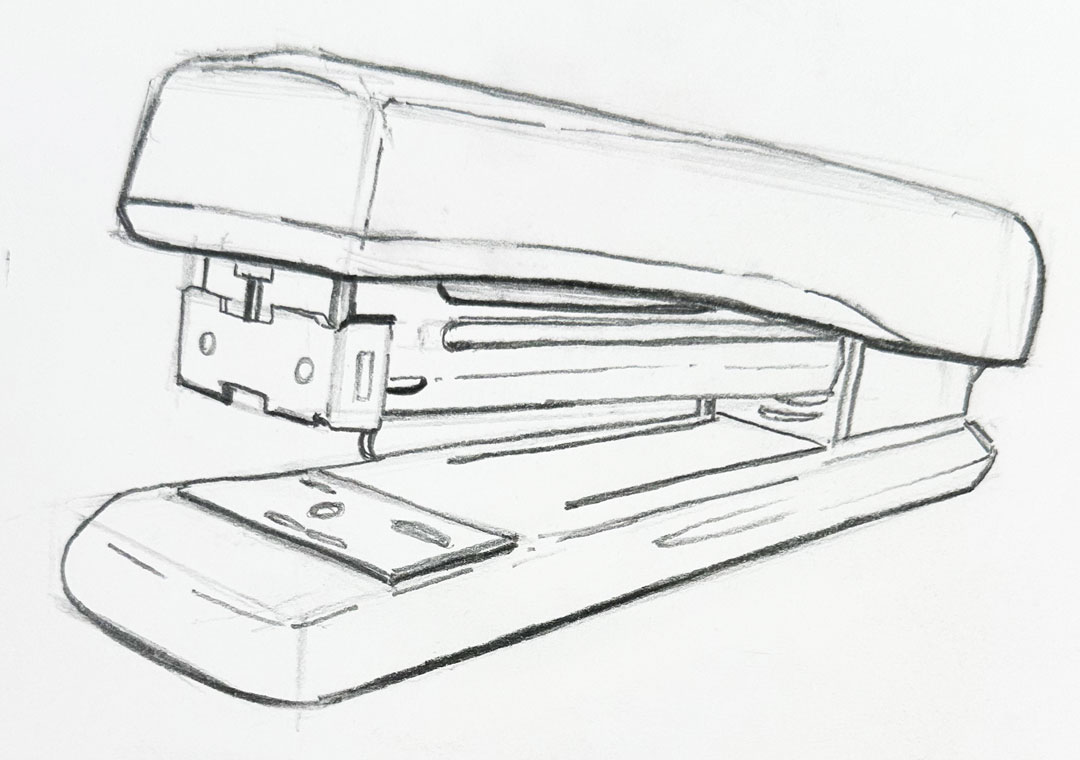
Take a stapler, for example. At first glance it appears fairly complicated, but when simplified, it becomes nothing more than a series of rectangles connected by a few gentle curves.
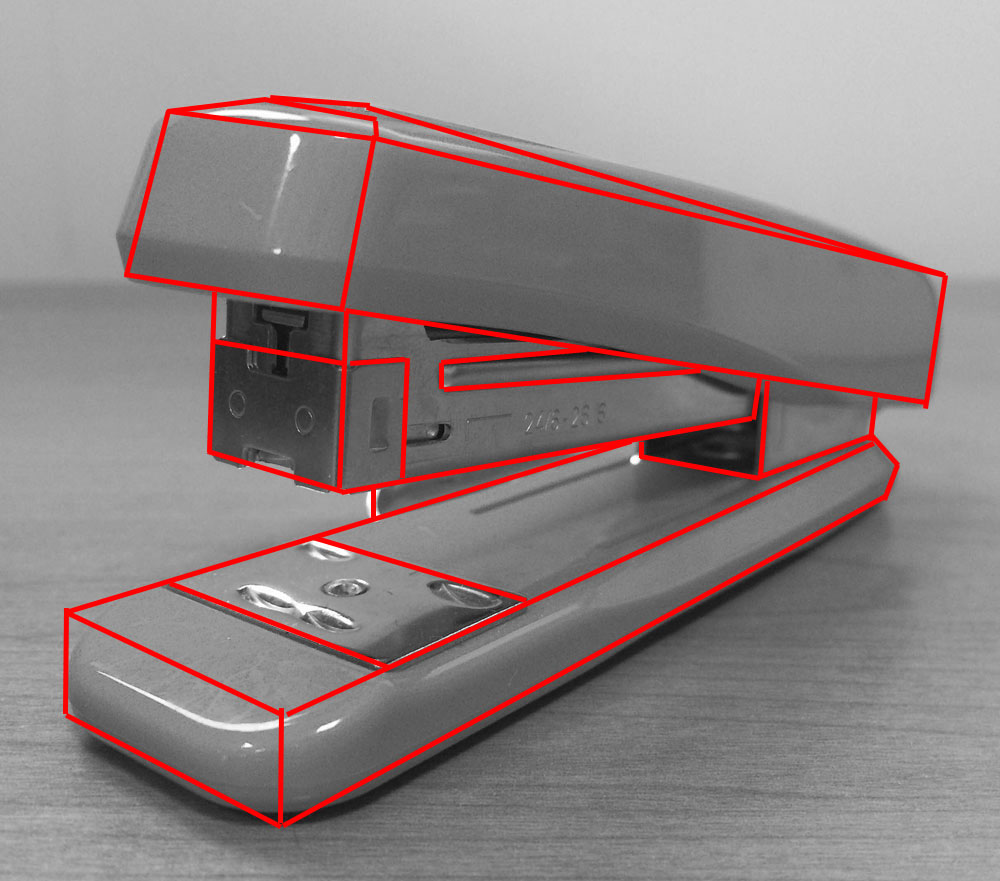
By sketching these large shapes first and gradually adding smaller ones, the entire structure falls into place naturally.
The same principle applies to more complicated objects like a spray bottle. Although its finished outline contains numerous curves and details, its underlying structure can be simplified into circles, rectangles, squares, and triangles. Once these shapes are accurately placed, drawing the finished contours becomes almost effortless.
Draw Lightly During the Construction Stage
During the initial stages, it’s important to draw with very light, loose marks. These construction lines are not intended to be part of the finished drawing. Instead, they act as guides that allow you to make adjustments as you work.
Once the basic structure is complete, you can lightly erase some of the construction lines and begin drawing the final contour lines with greater confidence.
At this stage, you’re no longer guessing where each line belongs—you already know because the underlying structure has been established.
Use Line Quality to Add Interest
As you draw the finished contours, think about line quality rather than simply tracing the edges of the subject.
Varying the thickness and weight of your lines creates visual interest while also suggesting light and form. Some lines can remain thin and delicate, while others become slightly thicker to emphasize shadow, overlap, or importance.
Even without adding any shading, thoughtful line variation can make a drawing appear far more dimensional and expressive.
Accuracy Leads to Confidence
One of the greatest benefits of drawing with shapes is the confidence it gives you throughout the drawing process.
Because you’ve carefully constructed the subject before adding details, every contour, feature, and edge has a logical place within the drawing. Instead of hesitating with each mark, you can draw more deliberately, producing cleaner, stronger lines.
This confidence often leads to better-looking drawings because your attention shifts away from worrying about accuracy and toward creating beautiful marks.
Drawing with Shapes Also Makes You Faster
Many artists are surprised to discover that this method not only improves accuracy—it also speeds up the drawing process.
At first, constructing subjects with basic shapes may seem like an extra step. However, once it becomes second nature, you’ll spend far less time correcting mistakes or redrawing inaccurate outlines.
The more you practice seeing simple shapes within complex subjects, the faster you’ll recognize patterns, establish proportions, and complete successful drawings.
Take Your Drawing Skills Further
Drawing with basic shapes is one of the most valuable skills any artist can develop because it forms the foundation for everything that follows. Whether your goal is realistic portraiture, landscape drawing, still life, or illustration, every successful drawing begins with strong construction.
Once you’ve mastered this process, you’ll be prepared to move on to more advanced concepts such as line quality, value, texture, and realistic shading. Together, these skills allow you to create drawings that are not only accurate but also expressive and visually engaging.
If you’d like to explore these concepts in greater depth, the Drawing Boot Camp 2.0 course provides more than 14 hours of real-time instruction covering how to truly see as an artist. You’ll learn how to build drawings with line and shape, create convincing value relationships, develop realistic textures, and complete finished drawings using a proven, step-by-step process.
The next time you begin a drawing, resist the temptation to start with the outline. Instead, look for the simple shapes hidden within the subject. Build those shapes one at a time, make comparisons as you work, and allow the contours to emerge naturally. You’ll be amazed at how much more accurate—and enjoyable—your drawings become.
If so, join over 36,000 others that receive our newsletter with new drawing and painting lessons. Plus, check out three of our course videos and ebooks for free.