
Subjects with Pen and Ink: Food

Course Curriculum
Lesson Description
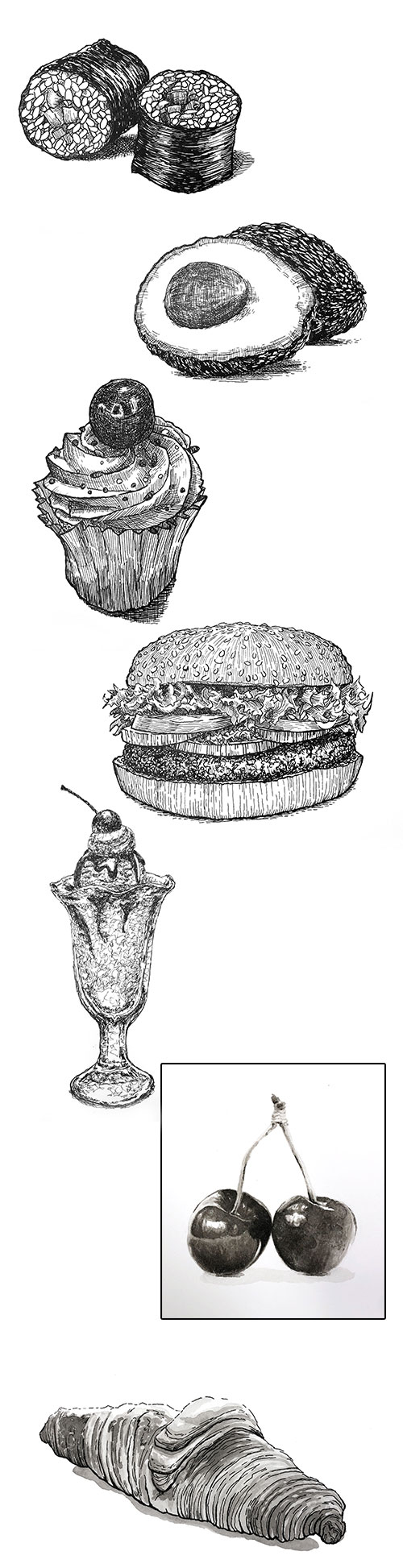
The Subjects with Pen and Ink: Food lesson series is part of the Subjects with Pen and Ink course, designed to help artists master expressive and realistic ink drawing through a variety of delicious food subjects. Over multiple lessons, students learn how to use pen, ink, and ink wash to depict everyday edibles — from sushi and avocado to cupcakes, hamburgers, ice cream, cherries, and croissants. This series emphasizes line work, value, texture, and composition, teaching techniques that bring ordinary food items to life with depth and personality.
Drawing Sushi and Avocado
The first lessons focus on sushi and an avocado. With sushi, students learn how to suggest texture — such as rice grains, seaweed, and fish — using expressive line patterns. The avocado lesson emphasizes smooth gradients and subtle value shifts achieved through controlled hatching and cross-hatching. Both subjects build confidence in observing form and applying line work to suggest volume and surface quality.
Cupcake and Hamburger Illustration
Next, students tackle a cupcake and hamburger. The cupcake drawing emphasizes decorative detail, from frosting swirls to wrapper folds, using fine lines and thoughtful line weight variation. The hamburger lesson focuses on multiple surfaces — crisp lettuce, juicy patty, and soft bun — requiring careful value placement and contrast to make each element readable and dimensional. These lessons reinforce how different textures behave under pen and ink.
Ice Cream and Cherries with Ink Wash
In the ice cream lesson, students learn to balance light and shadow with minimal line work, using hatching paired with subtle ink wash to suggest creamy form. The cherries drawing introduces ink wash more prominently, showing how diluted ink can create smooth tonal transitions and rich depth. The combination of line and wash helps unify the piece and convey reflective surfaces.
Croissant with Line Work and Ink Wash
The series concludes with a croissant that combines detailed line work with ink wash. Students learn how to map the complex folds of pastry with contour lines and then use ink wash to enhance shadows and volume. This lesson highlights how line and wash can work together to elevate realism and texture.
Developing Pen and Ink Confidence
By completing the "Food" lesson series, students gain practical experience in using pen, ink, and ink wash across a range of subjects and textures. The techniques learned — from expressive lines to tonal washes — build foundational skills for confidently drawing more complex subjects in pen and ink.
Specific Lessons
Lesson 10 - Sushi
In lesson ten, we use nib (or dip) pens and cross hatching to create a drawing of sushi on smooth Bristol paper.
Lesson 11 - Avocados
In lesson eleven, we use nib (or dip) pens and cross hatching to create a drawing of avocados.
Lesson 12 - Cupcake
In lesson twelve, we use nib (or dip) pens and cross hatching to create a drawing of a cupcake.
Lesson 13 - Hamburger
In lesson thirteen, we use nib (or dip) pens and cross hatching to create a drawing of a hamburger.
Lesson 14 - Ice Cream
In lesson fourteen, we use technical drawing pens and scribbling to create a drawing of ice cream.
Lesson 15 - Cherries
In lesson fifteen, we use ink wash to create a drawing of cherries.
Lesson 16 - Croissant
In lesson sixteen, we use ink wash and hatching to create a drawing of a croissant.
Lesson Materials
- Technical Drawing Pens
- Dip or Nib Pens
- Bottled Ink (Carbon Black)
- Smooth Bristol Paper
- Hot Press Watercolor Paper
- Nylon Brushes
- 2H, H, or HB Graphite Pencil
- Kneaded Eraser
Lesson Resources
References
Download eBook
Reference Images
Finished Drawing

Founder of The Virtual Instructor, artist and teacher. Matt makes learning art easy to understand and enjoyable.
Even though my first experience of ‘handwrighting’ 65+ years ago, was using a dip pen and dark blue claggy ink, my recent efforts have been disappointing. I have never been a believer in using specifically designed ‘left handed’ tools, but in this case wonder if it would make the learning experience easier? None of my local shops seem to stock pens described as suitable for left handed users – do they exist and if so, has anyone found them useful, or do I just need to persevere with the generic nibs I bought as a set? There are so many types and prices it’s hard to know.
Hi Barbara,
I can definitely see the need for a lefty pen when writing, but for drawing I think you can stick with the generic. If you start from the right and work your way to the left, you should be able to keep your palm out of the way and prevent any smearing.
Thanks, Matt, I am doing surprising well with the dip pens, a bit scratchy at first but with a bit more practice I’ll be fine – ands it’s fun!